

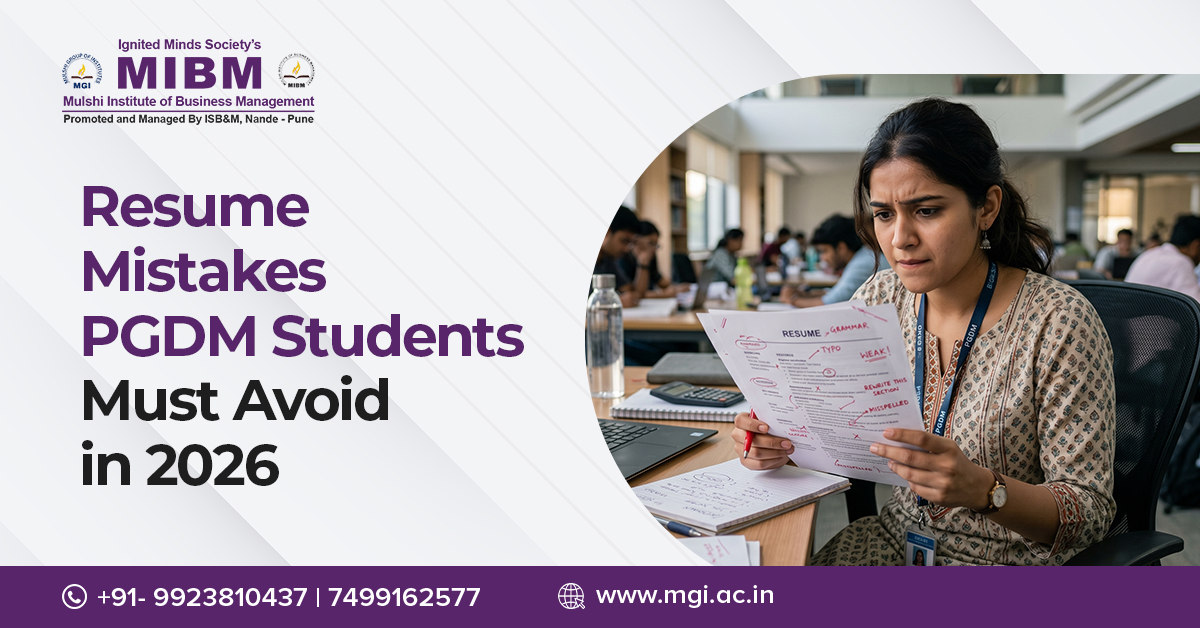
If you’ve been applying for jobs but aren’t getting any responses, the problem may not be related to your degree; The issue likely lies with your resume.
Recruiters won’t typically be spending time pouring over resumes with a cup of coffee in 2026; Rather, they’ll quickly be scanning through them and calling the best candidates to speak with via phone – and then moving on.
The purpose of your resume is to get the recruiter to stop what they’re doing and look at your resume; If you don’t achieve this, then you will no longer have the opportunity to have them look at your resume again.
For PGDM Program students, this can be even more critical due to the competition of hundreds of other candidates who have very similar skill sets. You will have to clearly demonstrate that you are different from everyone else not only by what you have accomplished but also by how clearly you convey that information on your resume.
Let’s go through where the biggest mistakes are made, how it affects your ability to be hired, and what you can do to address the areas of concern with your resume – especially if your background is in Marketing, Finance, HR or Business Analytics.
Common Resume Mistakes PGDM Students Make
Everything Sounds the Same
Pick up five PGDM resumes and you’ll notice something quickly—they all sound identical.
-
“Worked on marketing strategy.”
-
“Handled financial analysis.”
-
“Assisted in HR operations.”
There’s no personality, no context, and most importantly, no result. Recruiters aren’t looking for effort—they’re looking for impact.
If you’re a Marketing student, don’t just say you handled campaigns. Say what happened because of them. Did engagement go up? Did leads improve? Even a small number adds credibility.
If you’re in Finance, don’t just mention analysis. What kind of analysis? What insight came out of it? Did it help reduce cost or improve decisions?
The moment your resume starts sounding like everyone else’s, you’re invisible.
One Resume for Every Job
This is where most applicants quietly lose opportunities.
You apply for a marketing role, a sales role, and maybe even an operations role—with the same resume. It feels efficient, but it signals lack of focus.
Recruiters want alignment. If you’re applying for a Business Analytics role, they expect to see tools, data work, and problem-solving examples upfront. If that shows up somewhere at the bottom, it’s already too late.
Students from HR often make this mistake too. Their resumes include everything—recruitment, training, operations—but without clarity on what they actually want to pursue.
A resume should feel like it was written for that specific role, not copied and pasted.
Trying Too Hard to Impress with Design
Clean resumes work. Complicated ones confuse.
Still, a lot of PGDM students experiment with:
-
Colors
-
Icons
-
Fancy templates
It might look “modern,” but it often backfires.
Recruiters don’t care about design as much as clarity. In fact, when a resume becomes difficult to read, it creates friction. And friction leads to rejection.
A simple format doesn’t make you basic. It makes you readable.
No Real Proof of Work
This is where most resumes feel incomplete.
-
A Finance student writes: “Worked on financial modeling”
But what does that mean? Was it a college assignment? A real company project? What was the output?
-
A Marketing student says: “Handled social media”
But did it grow anything? Did engagement improve? Was there a strategy?
Without proof, everything feels like theory.
Generic Career Objectives
Unluckily most career objectives are ignored by the applicants themselves.
“Seeking a challenging role where I can grow…”
It sounds safe, but it says nothing.
A better approach is to be specific:
-
What role are you targeting?
-
What skills do you bring?
If a recruiter reads your resume and still can’t figure out what you want, they won’t spend time guessing.
Typos That Kill First Impressions
This one shouldn’t happen—but it does.
A single spelling mistake or formatting inconsistency can undo everything else. It signals carelessness. And in a competitive hiring environment, that’s enough to move your resume out of consideration.
Why These Mistakes Hurt Your Career
The Hiring Reality in 2026
|
What’s Happening |
What It Means for You |
|
Hundreds of applicants per role |
You are one among many |
|
Quick resume screening |
You don’t get time to explain |
|
Automated filters (ATS) |
Structure matters as much as content |
|
Skill-first hiring |
Proof matters more than claims |
The margin for error is small. Very small.
It’s Not About Being Qualified
Most PGDM students are qualified. That’s not the issue.
The issue is:
-
Your resume doesn’t highlight your strengths clearly
-
Your work looks similar to everyone else’s
-
Your story is not easy to understand
A recruiter won’t try to figure you out. If it’s not clear, they move on.
Missed Opportunities Add Up
One rejected resume doesn’t matter. But repeated rejections without feedback create confusion.
You start wondering:
-
“Is my profile weak?”
-
“Am I applying to the wrong roles?”
Sometimes, the answer is simpler. The resume isn’t doing its job.
How to Fix These Resume Mistakes
Start Thinking Like a Recruiter
Before adding anything, ask:
-
Is this relevant to the role?
-
Does this show impact?
-
Is this easy to understand quickly?
If the answer is no, it doesn’t belong.
Use Real Examples, Not Just Statements
For Marketing students, mention:
-
Campaign results
-
Content performance
-
Lead generation
For Finance students, include:
-
Analysis outcomes
-
Reports created
-
Tools used
For HR students, highlight:
-
Hiring numbers
-
Process improvements
-
Employee engagement initiatives
For Business Analytics, show:
-
Data sets worked on
-
Tools like Excel, SQL, Python
-
Insights generated
This is what makes your resume feel real.
Keep It Structured and Focused
Your resume should flow logically:
-
Education
-
Experience
-
Projects
-
Skills
Avoid jumping between unrelated sections. It creates confusion.
Add Numbers Wherever Possible
Even if approximate:
-
“Improved engagement by ~30%”
-
“Analyzed 500+ data entries”
Numbers make your work believable.
Cut the Extra Noise
Remove anything that doesn’t add value:
-
School-level achievements (unless exceptional)
-
Generic soft skills
-
Repetitive lines
Less content, more clarity.
Review It Like a Stranger Would
After writing your resume, step away and read it again.
Ask yourself:
-
Does this make sense in 10 seconds?
-
Can someone understand what I’ve done?
If not, simplify.
Resume Tips for Freshers (Stream-Focused)
Marketing Students
Your biggest advantage is visibility. Show what you’ve created.
Instead of just listing internships, highlight:
-
Campaigns you contributed to
-
Social media growth
-
Content strategy
Even college projects can work—if you explain them well.
Finance Students
Precision matters here.
Your resume should clearly show:
-
Analytical ability
-
Understanding of financial concepts
-
Tools like Excel or financial models
Avoid vague terms. Finance recruiters look for clarity.
HR Students
Don’t just list HR functions. Show involvement.
Mention:
-
Number of candidates handled
-
Recruitment processes
-
Any engagement activities
HR is about people—but your resume still needs structure and numbers.
Business Analytics Students
This is one stream where proof matters the most.
Mention:
-
Tools (Excel, SQL, Python)
-
Data projects
-
Insights generated
Even small projects can stand out if explained clearly.
About Mulshi Group of Institutes
At Mulshi Group of Institutes (MGI), the focus goes beyond classroom learning. For PGDM students, this matters more than it seems.
The institute encourages exposure through:
-
Practical projects
-
Industry interaction
-
Skill-based training
For students across streams like Marketing, Finance, HR, and Business Analytics, this creates opportunities to build real experiences—not just academic knowledge.
And that directly reflects in resumes.
A student who actively engages with these opportunities doesn’t struggle to fill a resume. They struggle to fit everything into one page.
That’s the difference the right environment can make.
Conclusion
A resume doesn’t need to be perfect. It needs to be clear.
In a crowded job market, the smallest improvements can create a big difference. Adding numbers, simplifying structure, and focusing on outcomes can move your resume from ignored to shortlisted.
Most students don’t lack potential. They just don’t present it well.
Fix that—and you change your chances completely.
FAQs
How long should a PGDM resume be?
For freshers looking to create a PGDM resume; typically; one page will suffice. A one-page resume is a more compact version of your resume which helps keep the resume content clean and concise, thus making it easier for recruiters to look through your resume after reviewing it.
Does having small mistakes on your resume truly make recruiters reject it?
Yes; Even small mistakes on your resume can negatively impact recruiters. Recruiters look for candidates who demonstrate attention to detail, which is important when applying for certain jobs.
Is it important to tailor each resume to the job you're applying for?
Yes; Some minimal adjustments made to correspond to the specific job you're applying for can help tremendously with getting an interview or job offer.
Can freshers beat experienced candidates?
Yes; freshers if presented properly can demonstrate their skills, projects, and potential against more experienced candidates.
What do you think is the worst mistake to make on your resume?
Being ambiguous is the biggest mistake you can commit on your resume. An unclear resume with little to no measurable outcomes is a surefire way to get rejected from a potential employer.