
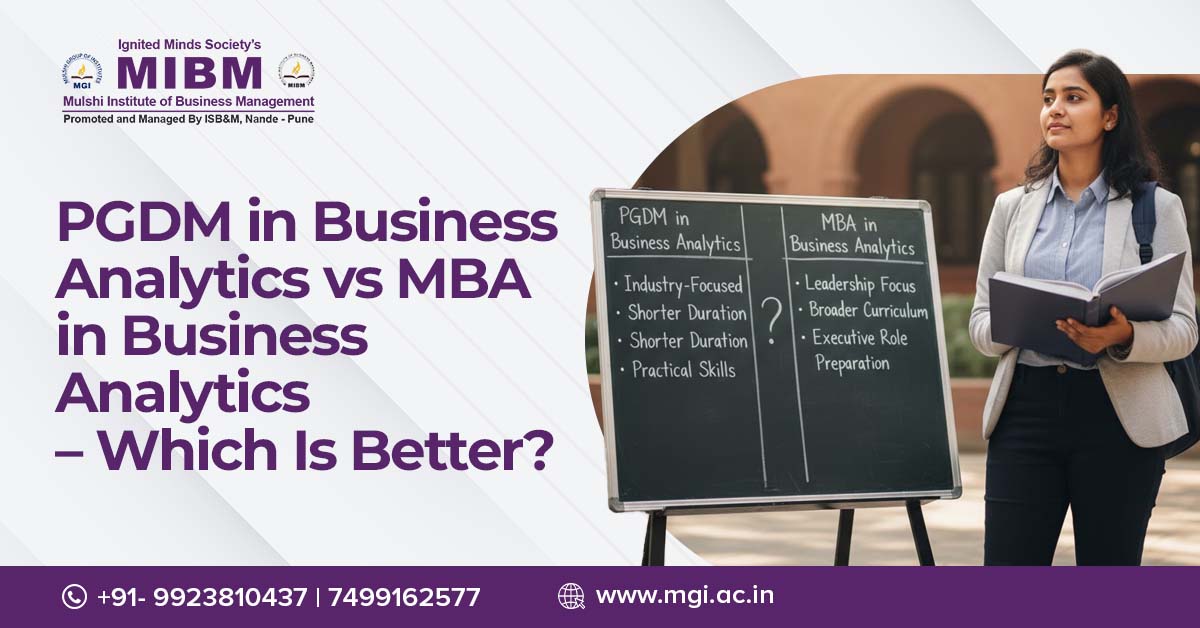
Business analytics has become a necessary skill, and those wanting to work in management are trying to decide which path is quicker: a traditional MBA or a PGDM that focuses on the industry. Since businesses are using data more and more, picking the degree that's right for you isn't just about the degree's name. It's about how useful your skills will be in a market where knowing algorithms and business strategies are both important. When comparing the two in 2026, the PGDM seems like the better option, especially when you see how schools such as the Mulshi Group of Institutes (MGI) organize and teach their analytics programs.
This article breaks down the important differences: how the curriculum is designed, how flexible it is, how relevant it is to the industry, how ready you are for placements, the long-term value, and who benefits most from each choice.
The Main Difference: What You Study and How It Relates to the Industry
MBA programs are usually controlled by universities. This means changes to the curriculum are slow because universities have many steps to complete before adding new technology, tools, or trends to what they teach. This can be a problem in business analytics, where AI tools change often.
On the other hand, a PGDM is independent. Schools such as MGI can change their program often, add new tools and technologies during the course, and work with mentors from the industry to create the coursework. This quick change means students learn what the industry is using now, not what was used five years ago.
This makes PGDM programs better for analytics careers, where employers want candidates who are ready to work from the start.
Flexibility and How Deeply You Learn: PGDM Is the Better Option
MGI's PGDM in Business Analytics uses a six-term model that combines management, technology, and practical analytics training. Students go through a natural learning process, starting with basic statistics and programming and moving to more advanced topics such as cloud computing, machine learning, blockchain, and data engineering.
MBA programs usually offer analytics as one area of focus but don't go as deep as PGDM programs. Many universities treat analytics as part of the broader MBA, not as a main subject that needs both technical and management skills.
The PGDM, especially MGI's program, is designed to treat analytics seriously. Students learn about data from all angles: business strategy, technology, and how to put it into practice. This is what employers need now.
The Advantage of Two Specializations: One of the Best Things About PGDM
The PGDM in Business Analytics at MGI allows students to study analytics along with another management area, such as marketing, HR, or finance. This combination is a career advantage because it gives students a mix of skills: they deeply understand data and know how a specific industry works.
For example:
- A marketing student who knows analytics becomes a performance strategist.
- A finance student who knows analytics is a great candidate for fintech and investment analytics jobs.
- An HR student who knows analytics becomes an expert in workforce planning, which is a role that companies need.
MBAs rarely offer this type of flexibility. Most MBA analytics programs only allow students to focus on one area, which limits the jobs they can apply for after graduating.
Teaching Style and What You Learn
MGI focuses on learning that's interactive and practical. Students study case studies, simulations, coding labs, cloud-based data projects, and real business situations. This allows them to create a collection of work that recruiters look for.
MBA programs, especially at traditional universities, still focus on theoretical teaching. While the management knowledge is strong, the technical learning isn't as deep because analytics isn't their main focus.
When preparing for roles such as business analyst, data analyst, analytics consultant, or decision science professional, having practical experience can be a deciding factor. This is where PGDM programs are better.
Industry Contacts and Being Ready for Placement
Since PGDM schools are independent, they create stronger connections with the industry, often directly with analytics firms, tech companies, and consulting organizations. MGI's business connections mean they can offer consistent placement support and more current hiring partnerships, which is a big benefit for analytics students.
MBA programs also place students, but their placement network is usually broader and less focused on analytics. The recruiters who visit traditional MBA campuses usually include banks, FMCG, retail, and business management firms, but recruiters who specialize in analytics prefer PGDM schools with a strong technical curriculum.
In 2026, companies want to hire people for roles that combine skills, where they need to understand data engineering basics, know how to use tools such as Python, R, and SQL, and be able to solve business problems. PGDM students usually fit this requirement better.
The ROI Question: Which Program Is a Better Value?
MBA programs tend to be more expensive because of their reputation and university facilities. However, the return on investment depends on how quickly you can use your knowledge to get high-paying jobs.
A PGDM in Business Analytics, especially from schools such as MGI that focus on skills, often gives a faster return on investment because:
- The curriculum is directly related to what high-growth industries need.
- Students get practical experience instead of just learning theory.
- Having two specializations widens job opportunities.
- Analytics careers are among the highest-paying in business.
MBA returns are good too but are usually more general. Graduates often compete for traditional management roles where growth is steady but slower.
If you want to move up in your career faster, the PGDM route usually pays off sooner.
Long-Term Career Path: Where Does Each Program Lead You?
Both degrees support long-term career growth, but PGDM students often move into leadership roles in tech companies faster because they understand analytics beyond the basics.
MBA graduates typically move into general management roles, strategic planning, consulting, or operations. Their career growth is more traditional and structured.
PGDM-Analytics graduates, on the other hand, are in a good position between business and technology. As companies automate operations and use data to make decisions, leaders with analytics training are some of the most valuable people to hire.
By 2030, leadership roles such as Chief Data Officer, Chief Analytics Officer, and Business Intelligence Head are expected to be some of the highest-paid positions in global companies. PGDM graduates are better prepared for this future.
Which Should You Choose?
Choose the PGDM in Business Analytics at MGI if you want:
- A curriculum that's updated for 2026 and beyond
- Strong technical and management learning
- Flexibility with two specializations
- Skills that are ready for the industry
- Faster return on investment
- Better chances in data-focused roles
Choose an MBA in Business Analytics if you want:
- A more traditional management degree
- More focus on business and less on the technical side
- A degree from a university that's recognized in academic circles
But for most people wanting a modern business education, especially those planning a career in data, PGDM is the better choice.
Final Decision: PGDM in Business Analytics Is the Better Choice in 2026
If you're comparing both programs in 2026, the PGDM is clearly the better option. It's more flexible, more related to what the industry needs, more practical, and better at preparing you for data-focused roles. MGI's program, in particular, provides a good balance of management, analytics, communication, and leadership, making graduates ready for the industry from day one.
The business world is changing faster than traditional degrees can keep up. A PGDM in Business Analytics makes sure you don't just keep up, but you lead.
FAQs
Is a PGDM in Business Analytics better than an MBA in 2026?
Yes. A PGDM offers a more current curriculum, stronger technical knowledge, and better connections to the industry, especially for analytics careers.
Does MGI offer a good PGDM in the Business Analytics program?
Yes. MGI's program covers analytics tools, dual specializations, practical learning, and good placement opportunities.
Which has a better ROI: PGDM or MBA in Business Analytics?
PGDM often has a faster ROI because it focuses more on skills and is connected to high-paying analytics roles.
Can PGDM graduates apply for analytics jobs worldwide?
Yes. The technical skills and management knowledge make PGDM graduates suitable for international analytics roles.
Is the PGDM curriculum more technical than an MBA?
Usually, yes. PGDM programs go deeper into analytics tools, machine learning, and cloud platforms than typical MBA programs.