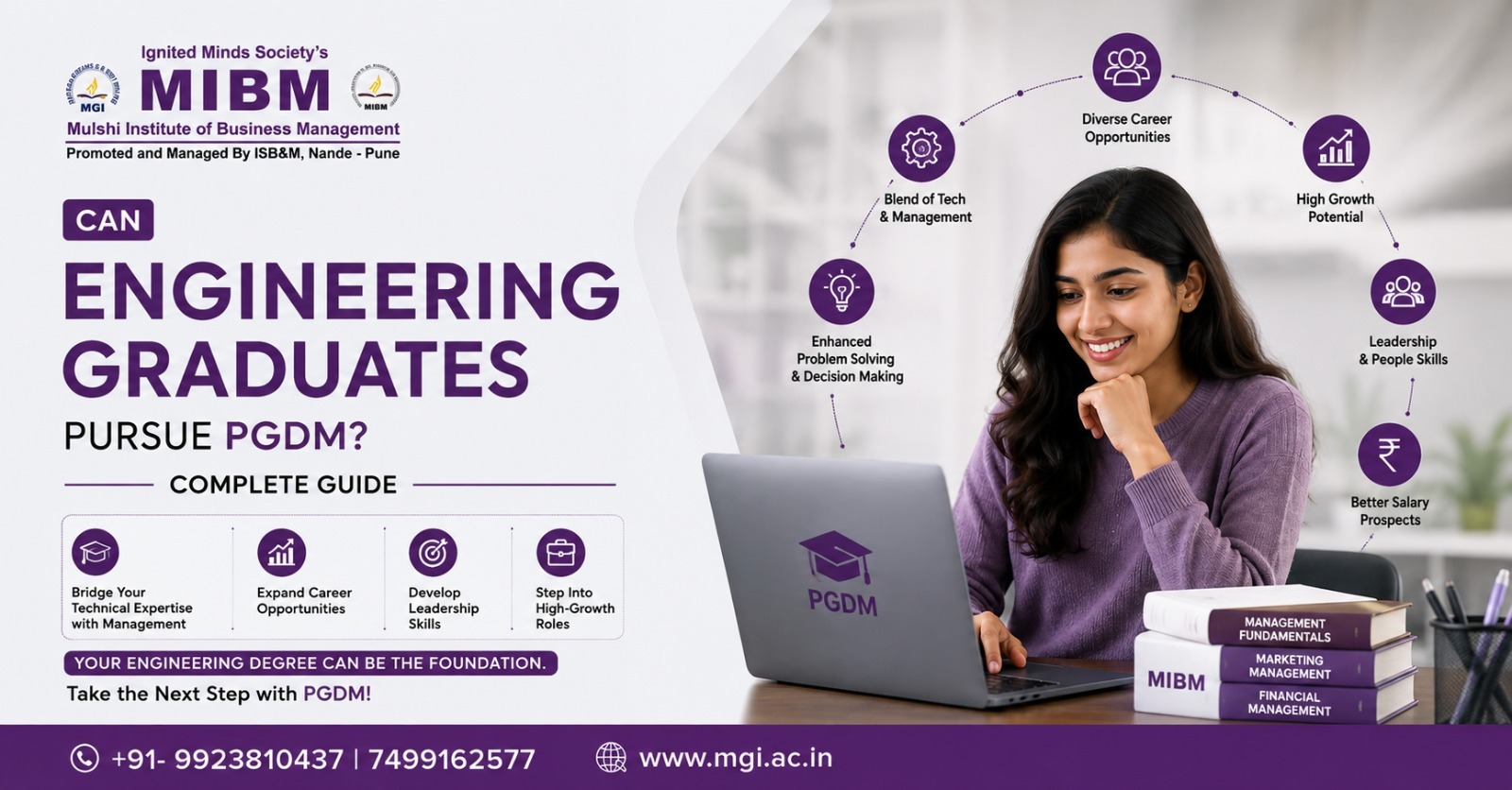
If you’re an engineering graduate in 2026 and wondering whether the PGDM Program is a smart option for you, our answer is: yes, undoubtedly.
In fact, with the modern job market, the combination of engineering and management makes one of the strongest career profiles.
Companies seek engineers who know business principles, strategies, and people management. PGDM does exactly that.
At Mulshi Group of Institutes (MGI), the PGDM course is tailored for graduates of any stream, including engineering. If you are from computer science, mechanical, civil, electronics, or any other stream, you can use PGDM in order to shift into management positions, instead of keeping the technical profile.
This guide will walk you through:
-
Eligibility for engineers
-
Why PGDM is a smart move after engineering
-
Best PGDM specializations for engineers
-
Career scope, roles, and salary expectations
-
How MGI supports engineering graduates in PGDM
Check PGDM Eligibility at MGI Pune
1. Eligibility: Can an Engineering Graduate Join PGDM?
Yes. The basic eligibility for PGDM at MGI is:
-
Graduation from any recognized university
-
Minimum 50% aggregate (45% for reserved categories)
-
Valid score in a recognized entrance exam (like CAT, MAH-MBA-MMCET, etc.) – as per institute rules
There is no restriction on your bachelor’s degree being only BBA or similar. Engineering graduates (B.Tech, B.E., B.Sc. Engineering, etc.) are fully eligible.
So, if you’ve completed engineering with the required percentage, you’re already qualified to apply for PGDM.
2. Why PGDM After Engineering Is a Smart Career Move
Many engineers feel stuck after graduation:
-
Jobs are not in their core branch
-
Roles are repetitive or low-growth
-
They want to move into management but don’t have the right qualifications
A PGDM solves these problems by:
a) Bridging the Gap Between Technical and Business Skills
Engineering teaches you:
-
Problem-solving
-
Analytical thinking
-
Domain knowledge
PGDM adds:
-
Business strategy
-
Marketing, finance, HR, operations
-
Leadership and communication
-
Decision-making in real organizational contexts
This combination is what companies value in managers, product heads, and business leaders.
b) Opening Doors to Management Roles
With only engineering, your roles are often limited to:
-
Technical engineer
-
Developer
-
Site engineer
-
Analyst
With PGDM, you can target roles like:
-
Business Manager
-
Product Manager
-
Operations Manager
-
Finance Manager
-
Marketing Manager
-
HR Manager
-
Supply Chain Manager
-
Business Analyst
These roles are not just better paid; they are also more future-proof and leadership-oriented.
c) Better Salary and Growth
On average, PGDM graduates earn 30% or more than their non-management peers. Many engineering graduates who switch to management after PGDM see a clear jump in salary and faster career progression.
In 2026, MGI reports:
-
Average PGDM package: around ₹9 LPA
-
Highest PGDM package: around ₹20 LPA
These numbers are especially strong for engineers who combine their technical background with a relevant specialization like Business Analytics, Supply Chain, or Finance.
Read More: Best PGDM Specialization in 2026
3. Best PGDM Specializations for Engineering Graduates
At MGI, PGDM offers specializations including:
-
Marketing
-
Finance
-
Human Resource Management
-
Supply Chain & Operations Management (SCOM)
-
Business Analytics
-
Health Care Administration (HCA)
-
Pharmaceutical Management
For engineers, the most natural and high-scope options are:
a) Business Analytics
Engineers already have:
-
Strong math and logic
-
Programming or data exposure
-
Analytical mindset
Business Analytics at MGI builds on this with:
-
Data visualization
-
Predictive modeling
-
Decision analytics
-
Consumer and operational analytics
This is one of the highest-paying and fastest-growing specializations in 2026.
b) Supply Chain & Operations Management (SCOM)
Especially for Mechanical, Civil, and Production engineers, SCOM is a perfect fit.
MGI’s SCOM program covers:
-
Logistics and distribution
-
Procurement and vendor management
-
Quality and lean operations
-
Technology in supply chains
Roles include Operations Manager, Supply Chain Manager, Logistics Manager, Inventory Controller – all with strong demand in manufacturing, e-commerce, and retail.
Note: At MGI, SCOM is especially designed for engineers, giving them a direct advantage in operations and supply chain careers.
c) Finance
Engineers often perform well in Finance PGDM because:
-
They are comfortable with numbers
-
They can handle quantitative models and cases
At MGI, Finance PGDM covers:
-
Corporate finance
-
Investment analysis
-
Financial modeling
-
Risk management
This opens doors to roles in banking, fintech, asset management, and consulting.
d) Marketing
If you enjoy communication, strategy, and customer behavior, Marketing is a great option.
Many engineers successfully move into:
-
Product Marketing
-
Brand Management
-
Sales & Business Development
-
Digital Marketing
Your technical background becomes a strong advantage when you sell technically complex products (IT, engineering, healthcare, etc.).
e) Human Resource Management (HRM)
For engineers who are good with people, teamwork, and leadership, HRM can be a strong choice.
Roles include:
-
HR Manager
-
Talent Acquisition Specialist
-
L&D Manager
-
Employee Relations Manager
Engineers in HR often bring a structured, process-driven approach that many organizations value.
4. Career Scope and Roles After PGDM for Engineers
With PGDM, engineering graduates can enter:
-
IT & Tech Companies: Product Manager, Business Analyst, Project Manager
-
Banking & Finance: Finance Manager, Risk Analyst, Investment Analyst
-
Manufacturing & Logistics: Operations Manager, Supply Chain Manager
-
Healthcare & Pharma: Hospital Administrator, Pharma Marketing Manager
-
Retail & E-commerce: Business Manager, Category Manager, Operations Lead
-
Startups: Business Development, Operations, Strategy roles
In short, PGDM gives you the flexibility to move from a purely technical path to a broader, strategic, and leadership-focused career.
5. How MGI Supports Engineering Graduates in PGDM
MGI’s PGDM program is built for students from diverse backgrounds, including engineers. Here’s how MGI makes it easier for you:
a) Industry-Aligned Curriculum
The curriculum is updated regularly to match 2026’s market needs, with practical cases, projects, and tools that companies actually use.
b) Strong Career Development Cell
MGI has a dedicated Career Development Cell that:
-
Organizes internships
-
Conducts mock interviews
-
Coordinates with industry partners for placements
-
Helps you build a professional profile
The average PGDM package at MGI is around ₹9 LPA, with the highest around ₹20 LPA, showing strong placement support for all graduates, including engineers.
c) Specialization Options That Match Engineering Strengths
Specializations like Business Analytics and Supply Chain & Operations Management are especially suited for engineers, leveraging their technical and quantitative strengths.
d) Flexible Entry Process
You can apply:
-
Online via the MGI admission portal
-
At the institute counter
-
Using a downloadable form with the application fee
This makes the process simple and transparent for engineering graduates coming from different cities and colleges.
Quick Summary: Should an Engineering Graduate Do PGDM?
-
Eligibility: Yes, engineers with 50%+ are eligible.
-
Career Scope: Very high – management, analytics, operations, finance, marketing, HR, healthcare, pharma.
-
Salary: Strong uplift; MGI’s average is ~₹9 LPA, highest ~₹20 LPA.
-
Best Specializations for Engineers: Business Analytics, Supply Chain & Operations, Finance, Marketing.
-
Future Potential: PGDM + engineering = leadership-ready profile for 2026 and beyond.
If you’re an engineer looking to grow beyond a purely technical role, PGDM is not just a “good option” – it’s often the smartest career investment you can make.
FAQs
1. Can engineers with less than 50% join PGDM at MGI?
Generally, no. The minimum is 50% for general category and 45% for reserved categories, as per MGI’s eligibility rules.
2. Is PGDM at MGI equivalent to MBA?
Yes. MGI’s PGDM is a 2-year full-time AICTE-approved program, treated as equivalent to MBA in the industry and by many employers.
3. Which PGDM specialization is best for CS engineers?
Business Analytics and Finance are ideal, as they build on your data, logic, and analytical strengths while opening high-paying roles in tech and finance.
4. Do I need to have work experience to join PGDM after engineering?
Not necessarily. Fresh engineering graduates can apply, though working experience (if any) can strengthen your profile during interviews and placements.
5. How does PGDM help engineers who want to stay in the tech industry?
It prepares you for roles like Product Manager, Project Manager, Business Analyst, and Tech Consultant – positions that sit between technology and business, where engineers with management skills are highly valued.